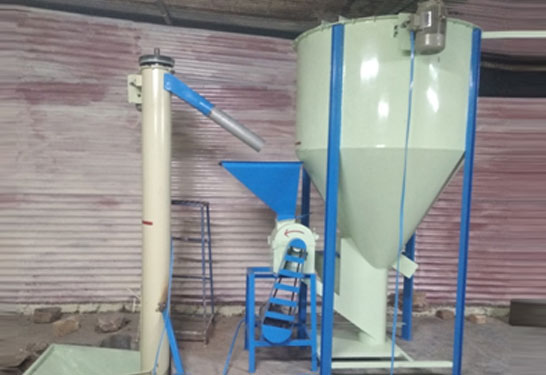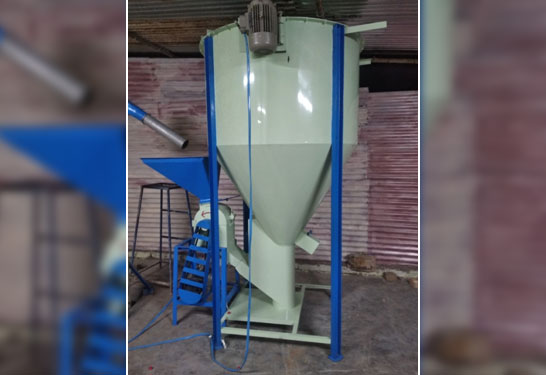

MINI ANIMAL FEED MILL
Most of the developed countries rely for their milk requirements on medium to large scale dairy farms; however, 80% of India’s milk production is contributed by small and marginal farmers having an average dairy herd of 2 animals. India has about 76 million farms involved in milk production. Most of these farms are households with dairying as a subsidiary occupation. Of late, medium scale family farms with 10-50 cows are making their presence felt representing about 15% of the milk production. Large scale commercial dairy farming is still at a very nascent stage with rough estimates of about 1% of dairy animals and 5% of milk production in India.
In the name of Dairy Development in India, most of the efforts are being done on forward linkages i.e. to channelize the rural milk output to urban milk market through dairy value chain. However, the way milk & milk products’ requirement of human beings is being addressed, the same parameters are not followed for dairy animals’ requirements. Therefore, if we look into Dairy Animals’ Requirements then find that major requirement is of dry matter (DM), which varies between 2 -3% of their body weight. This DM requirement is fulfilled through green fodder, dry fodder (straw/ stovers/ hay) and concentrate (Cattle Feed & feed ingredients namely broken grains, brans & oil cakes). Green & dry fodder requirements of dairy animals are being fulfilled locally by dairy farmers through green fodder & field crop residues. However concentrate portion of animals’ DM requirement, majority of dairy farmers are dependent on market for feed or little uses of locally available feed ingredients chiefly bran, husk & oil cakes.
There are various cattle feed brands available in market which are being supplied by Cooperatives, MPCs, MNCs and local feed manufactures and the current model of feed supplies is:
|
01
|
Feed Manufacturer (at limited locations across States) |
|
02
|
Distributor/ Dealer (at District/ Tehseel/ Town level) |
|
03
|
Retailer/ DCS (Dairy Coop. Soc.)/ MPP (Milk Pooling Point) (at Village Level) |
|
04
|
Dairy Farmer |
However, through this model we are able to cater around 20% cattle feed requirement of dairy animals (of total potential) even after 50 years of onset white revolution, a massive program on Dairy Development. It is happening because we are following western model of feed supplies. Since dairy animals’ presence in our country is up to millions of households across lakhs of villages therefore such scenario is limiting the expansion of cattle feed business in India due to logistic & other issues. Other undesirable features of current feed supply chain are:
|
01
|
Non professionals approach of Feed & Feed Ingredients’ Manufacturers/ Distributors/ Dealers |
|
02
|
Absence of legal framework towards manufacturing & sales of cattle feed & feed ingredients and such situation does not compel manufacturers & dealers/ distributors/ retailers to follow required minimum guidelines in regard to feed quality and they use to offer poor quality feed. |
|
03
|
Competition among Feed Manufacturers/ Distributors is about Price and not of feed quality. |
|
04
|
Absence of feed & feed ingredients quality control system at field level |
|
05
|
Higher prices of quality feed due to current supply chain and logistics model |
|
06
|
Purchase capacity of general dairy farmers does not allow to buy quality feed therefore they are forced to buy poor quality feed |
Such scenario is limiting the production potential of our dairy animals and dairy farmers are compelled to face below challenges related to dairy animals:
|
01
|
Longer Age at First Calving (AFC) therefore dairy animals take much time to come into production, and this factor severely diminishes the Productive Lifeof dairy animals |
|
02
|
Shorter Productive Life of dairy animals due to Longer Inter Calving Period&Shorter Lactation Length hence farmers use to leave such animals (cows) abandoned in open or sell them (especially buffaloes) to butchers at the very young age |
|
03
|
Less Milk Yieldalong with Low Total Solids (Milk Fat & SNF) in produced milk in comparison to genetic potential of animals in regard to milk production |
|
04
|
Higher Feeding Cost thus less profit from milk production |
|
05
|
Recurring Health Disordersin animals (due to imbalance feeding & nutrients’ deficiencies) like anoestrus, repeat breeding, RoP, Ketosis, Ruminal Acidosis etc. |
|
06
|
Non Judicious Useof available feed resources |
Therefore, if current cattle feed supply chain model is modified fromCENTRALIZED to DECENTRALIZED; we can succeed in many ways. Proposed DECENTRALIZEDmodel would be to establish MINI FEED MILLS (mash feed) at clusters of villages level. The animal feed manufacturing capacity of such mini feed mills would be 500 to 1000 kg per hour. One such unit of 500 kg capacity would be able to cater the feed requirement of approximately 500 dairy animals with below added benefits:
|
01
|
10-15% Reduced Feed Sales Price due to less expenses on manufacturing, transportation & margins of channel partners |
|
02
|
15 – 20% Improvement in Production of dairy animals |
|
03
|
Local Employment generation of 4 -6 individuals |
|
04
|
Suitable Uses of Locally Feed Itemsat farmers’ level i.e. grains, oil seeds, oil cakes |
|
05
|
Freshness & Quality of prepared feed |
|
06
|
Long Term Impact of such feed on dairy animals related to their heath & reproduction |
|
07
|
Reusable Feed Packing Material would enable us to reduce packing cost by 75% and plastic waste generation would also be reduced in the same tune. |
|
08
|
h) Locally available feed would not travel beyond neighboring villages/ locations therefore it will save cost of feed on one hand and save the local environment, too. |
FarmVic’sPackage related to Mini Animal Feed Mill involves:
|
01
|
Feasibility Study of the Project |
|
02
|
Detailed Project Report Preparation |
|
03
|
Linkage with Commercial Banks for financial support |
|
04
|
Supply of complete machinery & accessories related to Mini Animal Feed Mill |
|
05
|
Training of Feed Manufacturing for different animals’ categories |
|
06
|
Information Sharing of Raw Material Suppliers |
|
07
|
Supply of KEY INGREDIENTS |
|
08
|
Marketing Support |